Hey everyone,
Like many of you, I’m loving the new colorful monuments! They look awesome.
I was curious if the new colors changed the probabilities, especially for rares. I decided to run a test and make a large batch of Level 1 (L1) monuments to see what the numbers said. I’ve just finished my test after 500 makes.


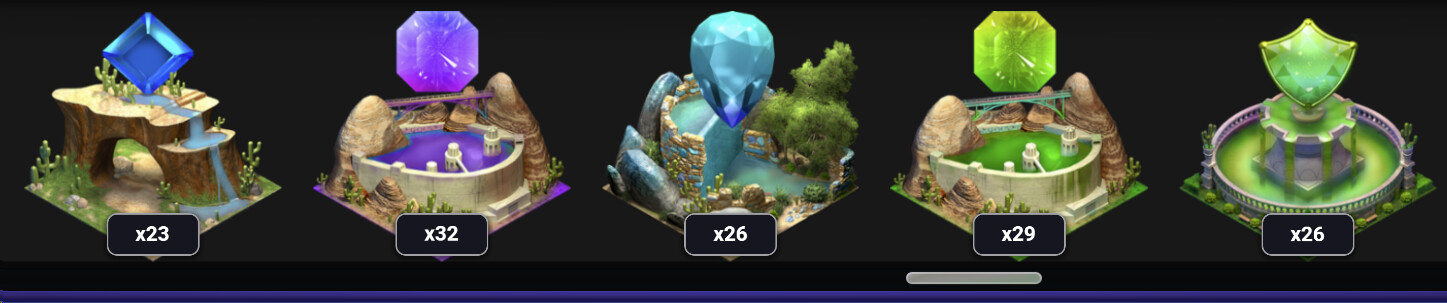
A Note on Evolution Paths
The test was for L1 crafting, but from what I’ve seen, the fundamental evolution paths are still the same. The color a monument starts with at L1 now determines the new colorful evolution path it will follow.
TL;DR: The 10% Rare Chance is Confirmed
The data strongly suggests the new colors were added to the ‘non-rare’ pool, and the fundamental rare chance remains the same.
Rare is still rare, holding at the historical 10% total chance.
The Final Test Data (Sample Size: 500)
I made 500 L1 monuments. Here is the summary of my results:
- Total Rare (Yellow) Monuments: 39
- Total Non-Rare (Color) Monuments: 461
This gives an observed rare rate of 39/500=7.8%. This is well within the expected statistical variance for a true 10% probability.
Here is the complete table of my results:
| Monument Name | Color | Count | Photo |
|---|---|---|---|
| Lustrous Fountain Crystal | Yellow Rare | 10 | |
| Golden Mesa Crystal | Yellow Rare | 7 | |
| Shining Forgotten Crystal | Yellow Rare | 10 | |
| Gleaming Reservoir Crystal | Yellow Rare | 12 | |
| Total Rares | 39 | ||
| Classic Fountain Crystal | Blue | 32 | |
| Ancestral Mesa Crystal | Blue | 23 | |
| Ancient Forgotten Crystal | Blue | 26 | |
| Arid Reservoir Crystal | Blue | 23 | |
| Arcane Fountain Crystal | Purple | 26 | |
| Mystic Mesa Crystal | Purple | 31 | |
| Shadowed Forgotten Crystal | Purple | 26 | |
| Ethereal Reservoir Crystal | Purple | 32 | |
| Grand Fountain Crystal | Green | 26 | |
| Vast Mesa Crystal | Green | 23 | |
| Desert Forgotten Crystal | Green | 24 | |
| Deep Reservoir Crystal | Green | 29 | |
| FIery Fountain Crystal | Red | 37 | |
| Burning Mesa Crystal | Red | 36 | |
| Cursed Forgotten Crystal | Red | 39 | |
| Molten Reservoir Crystal | Red | 28 | |
| Total Non-Rares | 461 | ||
| GRAND TOTAL | 500 |







The Mathematical Breakdown
Based on this data, the system is the results are consistent with a 10% rare pool and a 90% non-rare pool:
1. The ‘Rare’ Pool (10% Total Chance)
This 10% slice of the probability is reserved exclusively for the 4 rare yellow monuments.
- Chance for any rare: 10% (or 1 in 10 makes)
- Assuming an equal split, the chance for one specific rare monument is:
10% / 4 types = 2.5% (or 1 in 40 makes) - Data Check: With 500 makes, the expected count (the average) for each rare is
500 * 2.5% = 12.5. - Result: My observed counts of 10, 7, 10, 12 are all clustered very well around this expected value of 12.5.
2. The ‘Non-Rare’ Pool (90% Total Chance)
This is where all the new colorful monuments were added. The other 90% of outcomes are spread across these 16 non-rare items (4 series x 4 colors).
- Chance for any non-rare: 90% (or 9 in 10 makes)
- Assuming an equal split, the chance for one specific non-rare monument is:
90% / 16 types = 5.625% (or roughly 1 in 18 makes)
Standard Deviation Confirms It
To be extra sure, I ran the standard deviation on the non-rare pool to see if my counts were “normal” or just a lucky fluke.
- The expected count (the average) for each non-rare item was 28.125 (from
500 * 5.625%). - The standard deviation (SD) for this test is approx. 5.15.
- This means we can expect approx. 95% of the results for each item to fall within 2 standard deviations of the average (28.125).
- Expected 95% Range:
28.125 +/- (2 * 5.15)= [17.8, 38.4]
Now look at my 16 non-rare counts: (32, 26, 23, 23, 26, 31, 26, 32, 26, 23, 24, 29, 37, 36, 39, 28)
This is a textbook result. My lowest count (23) is well above the 17.8 floor. My highest count (39) is just outside the 95% range, which is perfectly normal (we expect 1 in 20 results to fall outside this range). All 16 counts are well within the 3-sigma range (99.7% of results).
Deeper Statistical Validation (For the Math Fans)
For those who love the hard numbers, here is a more rigorous statistical validation of the data, which confirms the model is a great fit.
-
Overall rare rate: 39/500 = 7.8%.
-
For n=500, p=0.10, the binomial SD is
sqrt(n*p*(1-p)) = sqrt(45) approx. 6.71. -
Z-score for 39 rares:
(39-50) / 6.71 approx. -1.64→ well within the 95% band (about 36.9 - 63.1). -
Wilson 95% CI for the observed rate: 5.76% - 10.49%, which includes 10%.
-
-
Split among the 4 rares:
-
If the rare pool is equal (2.5% each), expected per rare over 500 makes is 12.5. The counts (10, 7, 10, 12) are fine.
-
A quick chi-square test for equal split conditional on 39 rares (expect 9.75 each) gives
chi-square approx. 1.31with df=3 → no issue.
-
-
Non-rare items (16 types):
-
If the 90% pool is equally split, p=0.05625 each → expected 28.125 with SD
sqrt(n*p*(1-p)) approx. 5.15. -
The 16 counts: (32, 26, 23, 23, 26, 31, 26, 32, 26, 23, 24, 29, 37, 36, 39, 28)
-
95% range approx. 17.8 - 38.4; having one entry at 39 just outside is perfectly normal (approx. 1 in 20 outside). All are comfortably within 3-sigma (approx. 12.7 - 43.6).
-
-
Whole-table fit:
- Testing the 20-category table against the “10% equally split across 4 rares + 90% equally split across 16 non-rares” model gives
chi-square approx. 18.1with df=19 → do not reject (fits fine).
- Testing the 20-category table against the “10% equally split across 4 rares + 90% equally split across 16 non-rares” model gives
Conclusion
You can safely make the new monuments knowing that the ‘rare’ pool is separate and its 10% chance has not been diluted. The 10% rare / 90% non-rare split is statistically solid.
Hope this data helps everyone!
 .
.


 plus some sort of fuzzy logic you need to apply along with some maths lol.